
How we're using AI in our accounting firm
 Jack Ryder·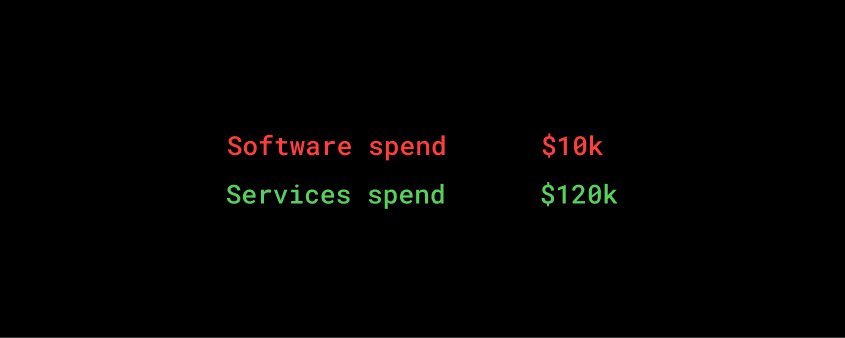
The past decade belonged to SaaS. The next decade might belong to AI-powered services.
Julien Bek from Sequoia wrote a fantastic piece last week on how services is the new software. So I wanted to build on his idea from the perspective of an AI powered services company to illustrate specifically what we're doing and how we see the future evolving.
The holy grail we're chasing at Flare: Services-level retention (90%+) with software-level margins (80%+).
For the first time ever, this feels possible.
The past 10 years celebrated SaaS, this was the game to be in - just look at the ~100 IPOs and insane returns from names like Salesforce, Adobe, ServiceNow etc. The next 10 years might see AI services companies prove to be the winning business model of this new generation.
The raw potential is there - as an accounting firm we sell an outcome to customers rather than a piece of software which is much more valuable. As Julien puts it; "for every dollar spent on software, six are spent on services. A company might spend $10K a year for QuickBooks and $120K on an accountant to close the books. The next legendary company will just close the books."
Combine that value with automation and you start to see the opportunity.
Getting specific, how do we make this happen?
Today AI provides intelligence, but humans still provide judgement. This is an incredible start because AI can continuously batch and automate tasks in parallel that were previously done sequentially by a human working 8 hours per day. As a result, the bulk of our focus at Flare so far has been on mining efficiency from putting intelligence to work, freeing human team members up to focus on judgement orientated tasks.
We're nowhere near done maximising this but here's some specific examples of what we're doing inside of our accounting firm today to drive both margin and customer experience. Note: we don't only think about efficiency in accounting work and are applying these same principles to other jobs like sales, billing, HR etc.
The core idea we have at Flare is that to reach software-esque margins, we must remove humans as the bottleneck in any workflow. Moving them into more of a review and judgement based role. Previously the understanding was humans would be the conductor but a lot of this orchestration can actually be handled by intelligence rather than judgement so I'm less keen on this analogy versus 3 months ago.
Flare Agent
We're building an internal AI agent at Flare which is already in production and used daily by our accounting team.
Right now humans trigger it for many workflows:
- Pull unreconciled transactions from Xero
- Update client query sheets
- Search across Notion, Drive and internal systems
- Execute routine accounting tasks
To build this we have had to ask ourselves, what exactly are we building because this isn't a SaaS tool (the UI is Slack), rather the concept of Harness Engineering which has sprung up over the past couple of weeks seems more appropriate. We see our job as building custom tools and skills for our agent to handle specific workflows inside our firm.
One interesting technical note: we explored the subagent path but, as Brett Taylor mentioned in a recent interview, we found the context just gets messed up in this architecture far too often for this agent approach to feel like a proper coworker. This lead us to switch to a skills based framework which is already far more reliable.
The future isn't inside of Slack however and we're currently working on enabling agents to trigger workflows themselves, unlocking true batch processing, raising exceptions to human team members as required through a kanban-style UI.
AI Generated Code
An accounting agent isn't the only tactic here. AI coding tools like Cursor and Claude Code make custom internal software nearly free. Since this is such a major reframing, we often force ourselves to ask the question, what would we build if the marginal cost of software was zero. One example answer to this question is our invoice reconciliation tool Luca which can be used by our humans and agent. This boosts margin and efficiency as we can design these tools for our unique internal workflows.
Going one step further, we realised that we can now afford to build custom applications/tools on a per client basis. Previously we had to turn down engineering requests if a request from the accounting team applied to a single client, given our limited engineering resources. But now we can spend 2 hours building a tool specifically for Client Y which can then be reused every month, saving up to 60% of human hours.
Change isn't easy
One essential ingredient in all of this is the humans on your team. They need to be smart enough to understand the significance of this change, be motivated to try new tools (that can sometimes break - usually my fault, not Cursor's) and be patient enough to deliver detailed feedback to the product team.
Thankfully at Flare we have an exceptionally high bar for talent and an incredible team which has helped make all of this smoother. To put numbers on it, more than 90% of our 30 person team had used our agent within the first few days.
I could write an entire article on how understanding existing workflows is crucial to identifying bottlenecks that can be solved with AI, but this is yet another example of where a good team adds tremendous value.
What comes next
Everything so far has been automating intelligence but what it means to automate judgement as AI gets better is an interesting thought experiment.
In reality, this likely means even more of the complex human tasks can be handed off to an agent, driving revenue per employee as our accountants can focus on client engagement, strategic advice and exception handling - ultimately offering an even better service.
Or maybe we'll be dealing with customer's own agents directly instead → see my previous post from last week on this.
One final question I think about: Do these margins eventually get competed away?
Possibly.
But even if they do, AI creates a massive window for fast-moving companies like Flare to capture enormous market share before the rest of the industry catches up.
And in industries like accounting - dominated by dinosaurs - that window could be very large.
More articles
Where do $100T companies come from?
Congratulations, you survived the AI jobs apocalypses of 2025 and 2026 (so far)!

Do we need a Company Brain or Nervous System?
AI models are already intelligent enough! So why is it still so hard to deploy AI inside a company?

The Great Orchestration
Today, everyone is focused on building better AI agents. The next bottleneck is orchestration.